
Melanoma or Liver Spots? How to Know If That Spot Needs Attention
What Are Liver Spots, Anyway?
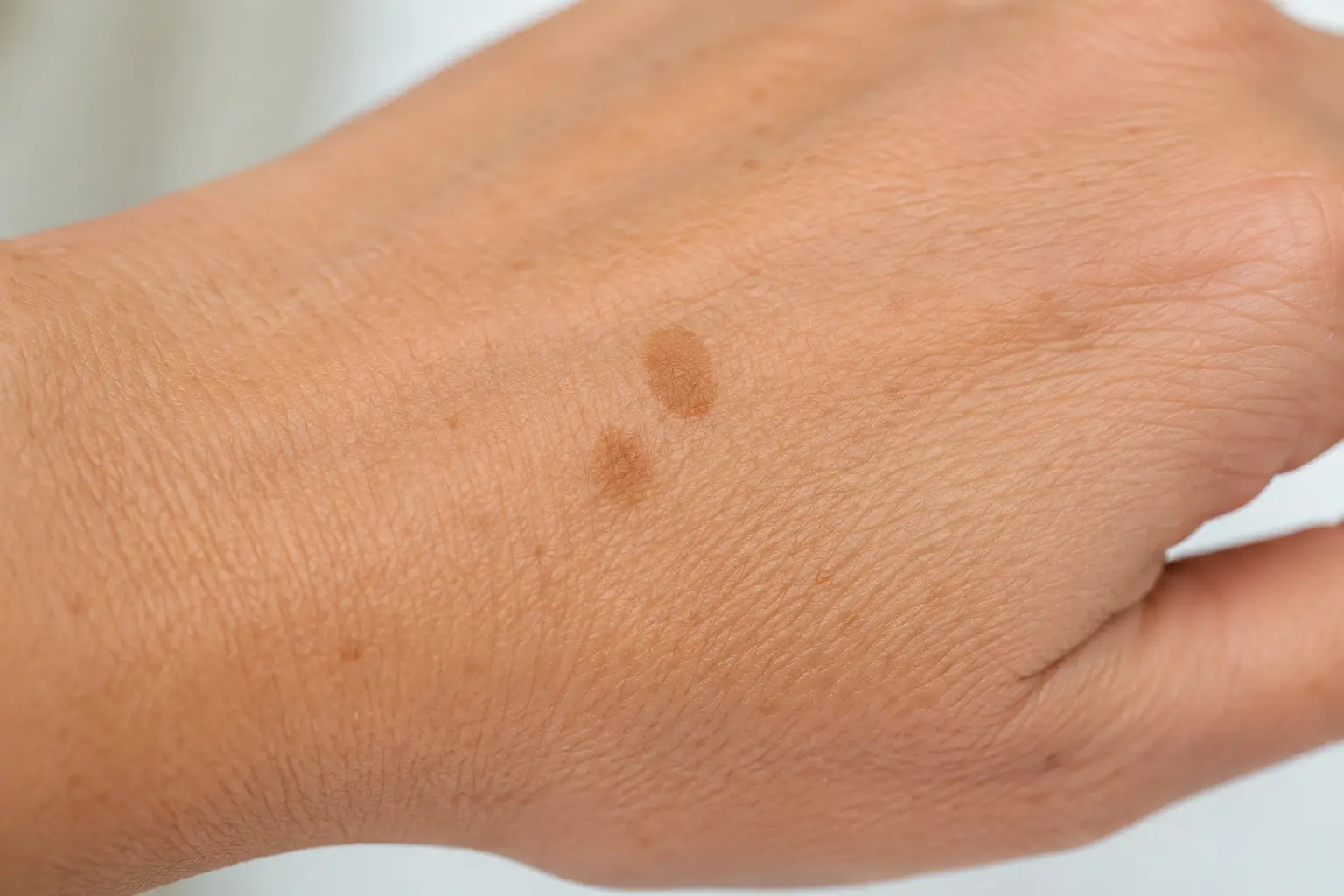
The name is misleading. Liver spots have nothing to do with your liver. They got that name because of their brown color, which loosely resembles the shade of animal liver, but the cause is entirely sun exposure.
Liver spots form when ultraviolet radiation from the sun or tanning beds causes your skin’s pigment-producing cells, called melanocytes, to go into overdrive in certain areas. Over years of exposure, those areas build up extra pigment, and flat, darkened patches appear. They show up most often on the face, hands, shoulders, forearms, and other areas that absorb the most sun. According to the Mayo Clinic, they’re most common in adults over 40 and become more frequent with age.
What do liver spots look like? They’re flat and smooth, not raised. They range from light tan to dark brown and are oval or round in shape. Most are somewhere between the size of a freckle and about half an inch across. They don’t hurt and they don’t itch. And they don’t change. That last part is one of the most important things to remember about true age spots.
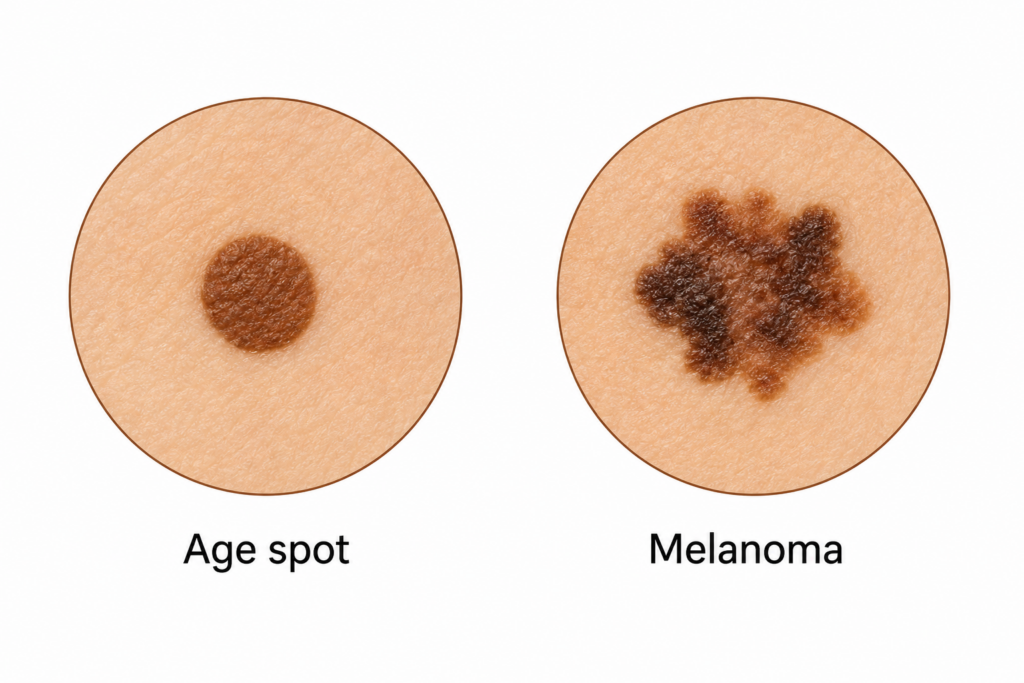
An age spot, also called a liver spot or solar lentigo, is a flat brown patch of skin caused by years of UV exposure. They appear most often on sun exposed areas like the face, hands, and shoulders. Age spots are not cancerous, don’t hurt or itch, and remain consistent in size, shape, and color over time. Any spot that grows, bleeds, or develops an irregular edge should be evaluated by a dermatologist.
Spotting Melanoma Before It Spreads
Melanoma doesn’t always look alarming at first. That’s part of what makes it dangerous. It can start as a brand new spot on otherwise normal skin, or as a quiet, gradual change in a mole or age spot that you’ve stopped paying close attention to. If you’ve ever talked yourself out of booking a dermatologist appointment because you figured a spot was probably nothing, you’re not alone. Most spots are nothing. But some aren’t.
Melanoma is the deadliest form of skin cancer. The American Cancer Society estimates that approximately 100,000 new melanoma cases are diagnosed in the US each year. As of 2024, your outcome depends enormously on how early it’s caught. According to the National Cancer Institute, melanoma detected before it spreads has a 5-year survival rate above 99 percent. Once it reaches distant organs, that number drops to around 35 percent. The gap between those two figures is why catching it early isn’t just helpful. It’s everything.
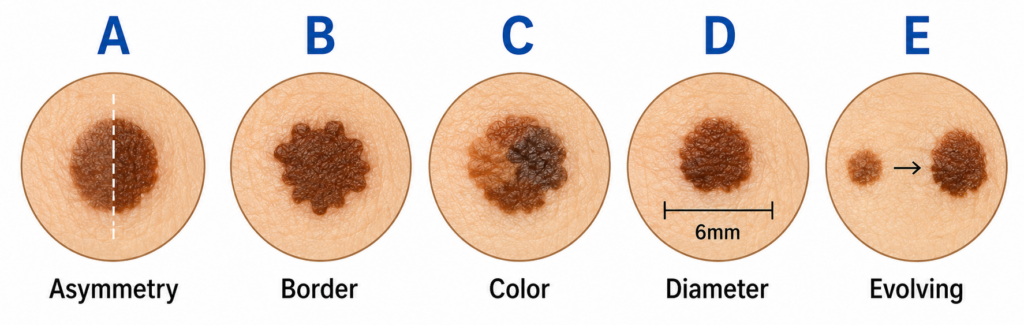
Dermatologists use the ABCDE rule to identify spots that deserve a closer look:
- A for Asymmetry. One half of the spot doesn’t match the other half.
- B for Border. The edges are ragged, notched, or blurry instead of smooth and defined.
- C for Color. Multiple shades appear in a single spot. Brown, black, red, white, or blue mixing together in one patch is a warning sign.
- D for Diameter. The spot is larger than 6 millimeters, roughly the width of a pencil eraser.
- E for Evolving. The spot is changing in size, shape, or color, or it’s starting to itch or bleed.
One of these signs is enough reason to see a doctor. You don’t need to wait until a spot checks all five boxes.
Melanoma Liver Spots vs Age Spots at a Glance
It can be genuinely hard to tell these two conditions apart by sight alone. Here’s a side by side look at how age spots and melanoma differ across the features that matter most when you’re doing your own skin check.
| Feature | Age Spot | Melanoma |
| Color | Even tan or brown | Multiple shades, may include black |
| Border | Smooth and defined | Ragged, blurry, or notched |
| Size | Stable over time | May grow or change |
| Surface | Flat and smooth | Can become raised or rough |
| Symptoms | Painless, no itch | May itch, bleed, or crust |
| Changes over time | None | Yes, often gradual |
The clearest signal of all is change. An age spot looks the same at 55 as it did at 40. A spot that’s shifting, growing, or developing an uneven edge is telling you something worth listening to.
Skin Tone Doesn’t Put You Off the Hook
A lot of people assume melanoma is mainly a concern for people with very fair skin. That’s a genuinely dangerous assumption. Melanoma can develop on any skin tone, and the fact that it’s often missed or dismissed in people with darker skin directly leads to worse outcomes.
According to the Skin Cancer Foundation, Black patients with melanoma are significantly more likely to be diagnosed at a later stage than white patients. One reason is that melanoma in darker skin tends to appear on areas that rarely see sunlight at all, like the palms of the hands, the soles of the feet, and beneath the nails. These aren’t spots you’d naturally examine during a routine self check.
Age spots also look different on darker skin. They may appear as slightly deeper or more concentrated patches rather than clearly distinct brown spots, making them easier to overlook. Whatever your skin tone, a full body skin exam with a dermatologist is the most reliable way to know what you’re actually dealing with.
When to See a Doctor About a Skin Spot
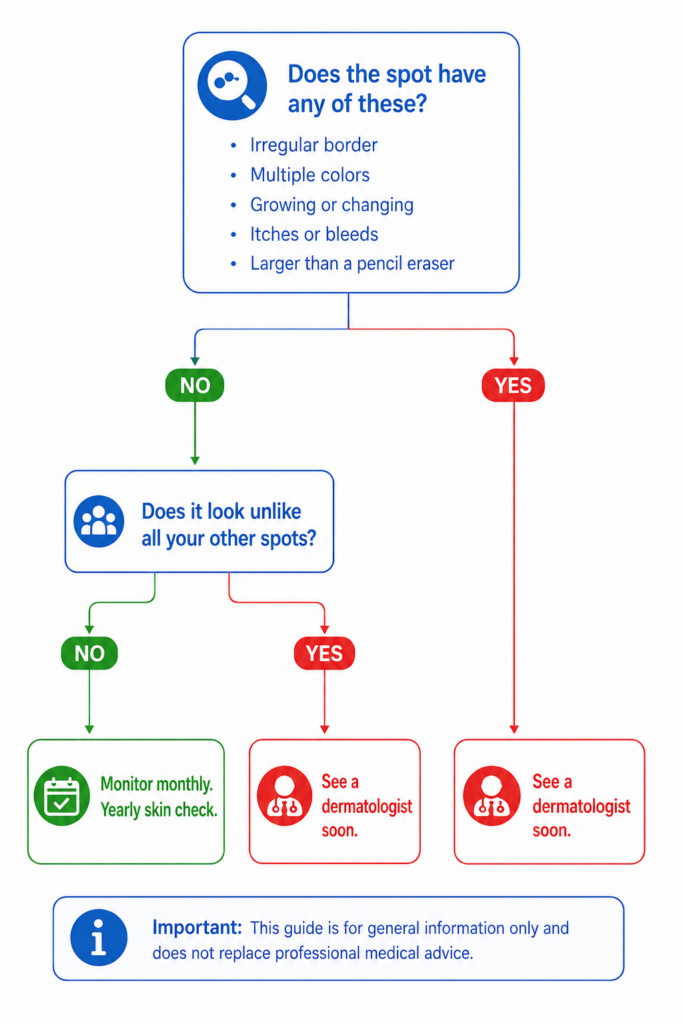
Most brown spots are harmless. But there are specific signals that should push you toward making an appointment sooner rather than later.
See a dermatologist if any spot:
- Has changed in size, shape, or color within recent weeks or months
- Bleeds, crusts, or oozes without a known injury causing it
- Itches or hurts
- Looks noticeably different from every other spot on your body (dermatologists call this the “ugly duckling” rule)
- Has multiple colors or an irregular, poorly defined border
You should also schedule a full body skin check if you have a personal or family history of skin cancer, a significant history of sun exposure or blistering sunburns, more than five moles with unusual features, or if you simply haven’t seen a dermatologist in several years. The USPSTF doesn’t currently recommend universal skin cancer screening for all healthy adults. But that guidance doesn’t mean you should skip it when you have clear risk factors. Ask your primary care doctor what makes sense for your specific history.
Treatment Options for Age Spots and Skin Cancer
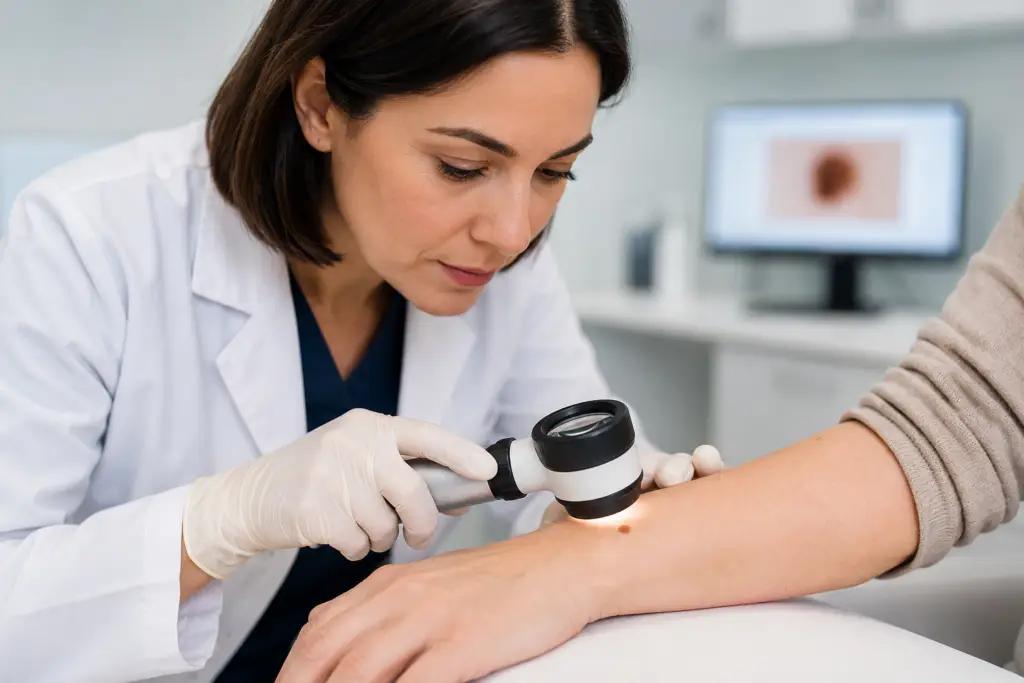
Age spots don’t need treatment. They’re harmless, and leaving them alone is completely safe. But if you want to lighten or remove them for cosmetic reasons, a dermatologist can offer several options:
- Prescription fading creams that often contain hydroquinone or retinoids
- Chemical peels that remove the outer layer of skin
- Laser therapy that targets pigmented cells specifically
- Cryotherapy, where liquid nitrogen freezes the darkened skin area
- Microdermabrasion, a physical exfoliation technique
Results depend on your skin type and the depth of the spots. Talk to a board certified dermatologist about which approach is safest for your complexion before starting anything.
Treating melanoma is a fundamentally different matter. Caught early, melanoma is typically removed with surgery, and cure rates are high. More advanced cases may involve immunotherapy, targeted therapy, radiation, or some combination of these. Your care team will build a plan based on the stage of the cancer and your overall health. The single most consistent factor in better outcomes is not waiting. Earlier treatment means more options and better results across every stage of this disease.
Protecting Your Skin Going Forward
The habits that reduce your melanoma risk are the same ones that slow down new age spot development. And you can start today, regardless of how much sun you’ve already had.
- Use broad spectrum sunscreen with SPF 30 or higher every day. The CDC recommends this as a core skin cancer prevention strategy, not just something to apply at the beach.
- Wear protective clothing, a wide brimmed hat, and UV blocking sunglasses when you’re outside during peak hours.
- Stay out of direct sunlight between 10 a.m. and 4 p.m. when UV intensity is at its strongest.
- Avoid tanning beds entirely. The International Agency for Research on Cancer classifies tanning devices as a Group 1 carcinogen, meaning the evidence that they cause cancer in humans is strong and clear.
- Do a monthly skin self exam. Use a full length mirror and a hand mirror to check areas that are hard to see, like your back and scalp. Taking photos over time helps you track whether anything is changing.
None of these steps are complicated. But done consistently over years, they make a real difference.
Your Skin, Your Call
Most flat brown spots are exactly what they look like: harmless age spots that are a normal part of getting older in the sun. But melanoma liver spots can appear just as quietly, in the same places, and look nearly identical at first glance. That’s why paying attention to change matters more than almost anything else. If a spot is shifting, causing symptoms, or simply looks different from the rest, trust that instinct and get it checked. At bannerhealth.io, we believe that early questions lead to the best outcomes. A short appointment with a dermatologist can give you a clear answer instead of months of quiet worry. You don’t have to guess.
The information on this page is for general educational purposes only and is not a substitute for professional medical advice, diagnosis, or treatment. Always talk with your doctor or another qualified healthcare provider about any questions you have regarding a medical condition. Never ignore professional medical advice or delay seeking it because of something you read on this website.
Frequently Asked Questions
What do liver spots look like?
Liver spots, also called age spots or solar lentigines, are flat, smooth patches of skin ranging from light tan to dark brown. They typically appear on areas with years of sun exposure, like your face, hands, shoulders, and forearms. They’re painless, not itchy, and stay consistent in size, shape, and color over time. If a brown spot is causing any discomfort or looks different from the others on your skin, have a dermatologist evaluate it.
How do you tell the difference between an age spot and melanoma?
The clearest way to distinguish an age spot from melanoma is the ABCDE rule. Age spots are symmetrical, have smooth defined borders, appear as a single even color, stay the same size, and don’t change. Melanoma tends to show at least one warning sign: asymmetry, irregular borders, multiple colors, a diameter above 6 millimeters, or noticeable change over time. If a spot checks even one of those boxes, see a dermatologist.
Can a liver spot turn into melanoma?
Liver spots themselves are benign and don’t transform into melanoma. But a rare type of skin cancer called lentigo maligna melanoma can closely mimic the appearance of an age spot, which is part of why the two are easy to confuse. Melanoma can also simply develop on the same sun exposed areas where age spots are common. Any spot that looks like an age spot but starts to change should be evaluated by a medical professional without delay.
What do age spots look like on darker skin tones?
On darker skin, age spots may appear as slightly deeper or more concentrated patches of pigment that blend into the surrounding skin, making them less obvious at a glance. Melanoma in darker skin tones tends to appear on areas that don’t get much sun, like the palms, soles of the feet, or under the nails. These spots are easy to miss without a proper skin check. Regular dermatology visits matter for every skin tone.
Is having many age spots a risk factor for skin cancer?
Having many age spots signals years of significant UV exposure, which is itself one of the main risk factors for skin cancer. But age spots are not cancerous and don’t directly raise your skin cancer risk on their own. Think of them as a reminder to take sun protection seriously and see a dermatologist regularly, especially if you have fair skin, a family history of melanoma, or a history of severe sunburns. Your doctor can help you decide how often to be screened.
Written by Theo James
The information on this page is for general educational purposes only and is not a substitute for professional medical advice, diagnosis, or treatment. Always talk with your doctor or another qualified healthcare provider about any questions you have regarding a medical condition. Never ignore professional medical advice or delay seeking it because of something you read on the internet.