
Shilajit and ashwagandha solve different problems. Shilajit is a mineral rich resin with its best evidence in testosterone and energy support, especially for men. Ashwagandha is an herb with its best evidence in lowering cortisol, easing stress, and improving sleep. Pick based on your main complaint, and stack them only with your doctor’s sign off.
Both show up in the same wellness circles and supplement stacks, and they get treated as interchangeable adaptogens. They are not. Here is a straight comparison of what each one does, what the research supports, and how to decide.
Shilajit vs Ashwagandha at a Glance
| Feature | Shilajit | Ashwagandha |
| What it is | Mineral resin from Himalayan rock | Root extract of the Withania somnifera herb |
| Main active compound | Fulvic acid | Withanolides |
| Best evidence for | Testosterone, male fertility | Cortisol reduction, stress, sleep |
| Also studied for | Energy, cognition, blood sugar | Anxiety, athletic recovery, thyroid function |
| Common dose | 300 to 500 mg daily | 300 to 600 mg daily |
| Best time to take | Morning | Evening for sleep, anytime for stress |
| Biggest quality risk | Heavy metals in unpurified resin | Weak extracts without standardization |
| Avoid if | Iron overload, blood disorders, pregnancy | Pregnancy, thyroid medication without supervision |
The rest of this guide unpacks each row, because the details decide which one fits you.
What Shilajit Does Best
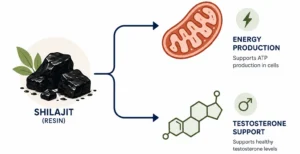
Shilajit is a thick, resinous substance that seeps out of rock layers in the Himalayas and other high altitude ranges when temperatures rise. It forms over hundreds of years as plant matter and minerals compress inside rock, producing a substance rich in fulvic acid, humic acid, and more than 84 trace minerals.
Testosterone and male fertility carry the strongest data. A 2015 controlled trial published in Andrologia found that healthy men who took 250 mg of purified shilajit twice daily for 90 days saw significant increases in total testosterone, free testosterone, and DHEA-S levels compared to a placebo group. That is meaningful data from a peer reviewed trial, even though larger studies are still needed. Early research also suggests improvements in sperm count and motility, with small studies pointing in a consistent direction.
Energy comes second. Shilajit appears to support energy production by helping mitochondria work more efficiently. A 2012 study in the Journal of Medicinal Food found reduced chronic fatigue symptoms in animal models. Human trials are limited, but the mechanism is biologically sound.
Brain health and blood sugar are early stage. Cellular research suggests fulvic acid may interfere with the tau protein buildup linked to Alzheimer’s disease, and animal studies hint at blood glucose effects. The NIH National Center for Complementary and Integrative Health notes this research is promising but unconfirmed by large human trials. Worth watching, not worth overclaiming, and never a substitute for established treatment if blood sugar is your primary concern.
Some users also report clearer skin over time, likely tied to fulvic acid’s antioxidant activity, though direct human studies on shilajit for skin are still missing.
What Ashwagandha Does Best
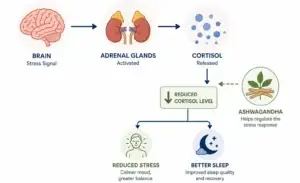
Ashwagandha is a root extract used in Ayurvedic practice for centuries, and unlike most traditional herbs, its core claim has been tested repeatedly in human trials.
Stress and cortisol are its home ground. As the Mayo Clinic notes in its ashwagandha overview, multiple randomized trials have found meaningful reductions in perceived stress and cortisol levels versus placebo, typically at 300 to 600 mg of root extract daily over 8 or more weeks.
Sleep is the second strength. Several trials report faster sleep onset and better sleep quality, which is why evening dosing is common. If sleep is your main goal, ashwagandha competes with other sleep aids we have covered, like the melatonin blends in our guide on whether sleep gummies work, and it works through a different pathway, stress reduction rather than sedation.
Testosterone effects exist but are smaller. A few trials show modest testosterone increases in men, usually alongside stress reduction, suggesting the effect may come from lowering cortisol rather than driving hormone production directly. If testosterone is the specific goal, shilajit has the more direct evidence.
So Which One Should You Take?
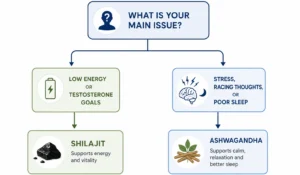
Match the supplement to your primary complaint, not to the marketing.
Choose shilajit if your main issues are low energy, physical fatigue, or you are a man specifically targeting testosterone or fertility markers with your doctor’s knowledge.
Choose ashwagandha if your main issues are stress, racing thoughts at night, poor sleep, or feeling wired and tired at the same time. Cortisol is the lever here, and ashwagandha pulls it more reliably than any other adaptogen studied so far.
If your problem is “all of the above,” start with one, not both. Run it for 8 to 12 weeks, judge the effect, then decide whether the second one still seems necessary. Starting both at once means you will never know which one is working.
Can You Take Shilajit and Ashwagandha Together?
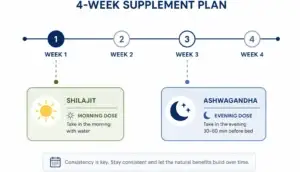
Yes, and the stack is popular for a reason. The two target different but overlapping systems. Shilajit leans toward physical energy, testosterone support, and mineral replenishment. Ashwagandha leans toward cortisol, mood, and sleep. Together they may address stress resilience, hormonal balance, and sustained energy at once.
Three rules make the stack sensible rather than reckless.
- Introduce them two weeks apart. If a side effect shows up, you will know which supplement caused it.
- Keep doses at the low end of each range to start, 300 mg shilajit in the morning and 300 mg ashwagandha in the evening is a common pattern.
- Clear it with your doctor first, especially if you take any prescription medication. Both supplements interact with medication classes listed below, and stacking multiplies the unknowns.
Dosage and Timing for Each
Shilajit. Most research used 250 to 500 mg per day. Take it in the morning, on an empty stomach or with a light non caffeinated meal. The traditional method dissolves a pea sized amount of resin in warm water or milk. Avoid evening doses, since its energy effects can disturb sleep in the early weeks. Many practitioners suggest cycling, three months on, two to four weeks off, though formal research on cycling is limited.
Ashwagandha. Trials typically used 300 to 600 mg daily of a standardized root extract. For sleep, take it in the evening. For daytime stress, morning or split dosing works. Effects build over weeks, not days, so judge it at the 8 week mark, not the first few nights.
How to Buy Each One Without Getting Burned
Quality varies more in these two categories than almost any other supplement, and the failure modes are different.
For shilajit, the danger is contamination. Raw, unpurified shilajit can contain lead, arsenic, and mercury at genuinely harmful levels. Only buy products labeled purified or processed, with a standardized fulvic acid percentage, typically 60 to 80 percent, and third party lab certification such as USP or NSF. The Cleveland Clinic points to third party testing as one of the most reliable markers of a trustworthy supplement, and it matters doubly here.
For ashwagandha, the danger is weakness. The herb itself is safe to grow and cheap to powder, so the market is full of underdosed products. Look for a standardized root extract with a stated withanolide percentage, and match the label dose to the 300 to 600 mg range the trials actually used. Skip proprietary blends that hide amounts.
As the FDA states on its dietary supplements page, supplements are not evaluated for safety or effectiveness before reaching shelves. The label checks above are your only real quality control.
Who Should Avoid Each One
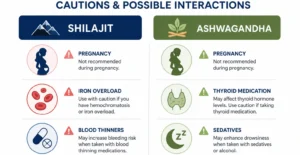
Do not take shilajit if you are pregnant or breastfeeding, are under 18, have hemochromatosis or any iron overload condition, have sickle cell anemia or thalassemia, or take blood thinners, insulin, or blood pressure medication without medical supervision. Shilajit is high in iron and interacts with these situations directly.
Do not take ashwagandha if you are pregnant, since it has been linked to potential risks in pregnancy, or if you take thyroid medication, since ashwagandha can raise thyroid hormone levels and push a managed dose out of range. People on sedatives or immunosuppressants also need medical guidance first. Rare cases of liver injury have been reported with ashwagandha, so any dark urine or jaundice means stop immediately.
Stop either one and call your doctor if you notice rapid heartbeat, hives or swelling, persistent nausea, or worsening fatigue after starting.
The Bottom Line
Shilajit and ashwagandha are the rare traditional supplements with genuine, if early, evidence behind them, but they earn their place for different jobs. Shilajit’s case is strongest for testosterone and energy. Ashwagandha’s case is strongest for stress and sleep, and it is the better studied of the two overall. Pick the one that matches your primary complaint, buy a third party tested product, give it 8 to 12 weeks, and involve your doctor if you take any medication or plan to stack them.
Frequently Asked Questions
Which is better for testosterone, shilajit or ashwagandha?
Shilajit has the more direct evidence. A 90 day controlled trial found significant increases in total and free testosterone in healthy men taking 250 mg of purified shilajit twice daily. Ashwagandha shows smaller testosterone effects that likely come from lowering cortisol rather than acting on hormones directly. For stress driven low energy, ashwagandha may still help more overall.
Can I take shilajit and ashwagandha at the same time?
Yes, the combination is common and the two work through different pathways. Introduce them two weeks apart so you can trace any side effect to its source, start at the low end of each dose range, and check with your doctor first if you take any prescription medication.
How long do shilajit and ashwagandha take to work?
Both build gradually. Ashwagandha trials typically show stress and sleep improvements by 8 weeks. Shilajit’s testosterone data comes from a 90 day trial. Judge either supplement after 8 to 12 weeks of consistent use, not after the first week.
What is the best time of day to take each?
Shilajit works best in the morning, since its energy support can disturb sleep if taken late. Ashwagandha is usually taken in the evening when sleep is the goal, or in the morning for daytime stress. If stacking, the natural split is shilajit with breakfast and ashwagandha before bed.
Is shilajit safe? What should I check before buying?
Purified shilajit at 250 to 500 mg daily is generally well tolerated by healthy adults. The real risk is unpurified products, which have tested positive for lead, arsenic, and mercury. Only buy resin or capsules labeled purified, with a standardized fulvic acid percentage and third party lab certification. People with iron overload conditions, blood disorders, or on blood thinners should avoid it.
What are the side effects of ashwagandha?
The common ones are mild drowsiness and stomach upset. The important ones are rarer: it can raise thyroid hormone levels, which matters for anyone on thyroid medication, and rare liver injury cases have been reported. Pregnant women should not take it. Stop and see a doctor for dark urine, yellowing skin, or persistent digestive problems.