
The 4 month sleep regression is the big one, because it is not actually a phase. Around this age your baby’s sleep permanently reorganizes into adult like cycles, which is why waiting it out works worse here than at any other age. The fix is a schedule built around wake windows and settling skills. Every other regression, at 8 months, 12 months, and 18 months, genuinely does pass on its own.
Your baby slept through the night for weeks, and now she is up every two hours again. This guide starts with the 4 month regression because it changes the rules, then covers every other age so you know what is coming and how long each stage lasts.
Why the 4 Month Regression Is Different
Every other sleep regression is temporary: a growth spurt, a new skill, a molar, and then sleep snaps back. The 4 month regression is a permanent upgrade to how your baby sleeps.
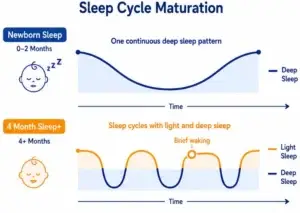
Newborns drop straight into deep sleep. Around 3 to 4 months, that pattern matures into cycling between light and deep sleep the way adults do. Adults surface briefly between cycles, roll over, and drift back without remembering it. A baby who surfaces between cycles and does not know how to fall back asleep on her own calls for the only solution she knows: you.
That is why the 4 month regression is really a settling skill problem, and why the habits you build now stick. A baby rocked or fed to sleep at every waking learns that sleep starts with rocking or feeding, then requests it at every cycle break, all night. A baby who practices falling asleep on her own carries that skill through every future cycle break, and through every future regression too.
The 4 Month Survival Schedule
At this age most babies need 12 to 16 hours of total sleep, take 3 to 4 naps, and can only handle about 1.5 to 2.5 hours of awake time before overtiredness kicks in. Overtiredness is the enemy: an overtired baby fights sleep harder and wakes more, which is the exact opposite of what exhaustion logic suggests.
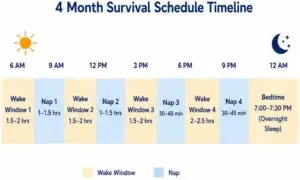
Here is a sample day. Treat it as a template to shift around your baby’s natural wake time, not a clock to obey.
| Time | What Happens |
| 6:30 am | Wake and feed |
| 8:00 to 9:15 am | Nap 1 |
| 9:15 am | Feed, play |
| 11:00 am to 12:15 pm | Nap 2 |
| 12:15 pm | Feed, play |
| 2:00 to 3:00 pm | Nap 3 |
| 3:00 pm | Feed, play |
| 4:45 to 5:15 pm | Short catnap if needed |
| 6:00 pm | Bath, feed, wind down routine |
| 7:00 to 7:30 pm | Down for the night, drowsy but awake |
Three rules make the schedule work.
- Watch the wake window, not the clock. If your baby shows sleepy cues at 90 minutes, start the nap. Stretching an awake window to match the printed schedule backfires.
- Protect the first nap. The morning nap anchors the whole day. A blown first nap usually cascades into an overtired evening.
- Put her down drowsy but awake at bedtime. This is the single practice that addresses the actual problem, settling skill. She does not have to master it at every nap, bedtime is the highest value rep.
One more tool: when she surfaces and fusses at night, pause a few minutes before intervening. Babies make noise between cycles without being fully awake, and rushing in can wake a baby who was about to resettle herself.
What Is Sleep Regression
Sleep regression happens when a baby or toddler who was sleeping well suddenly starts waking more often, fighting naps, or refusing to settle at bedtime. The cause usually traces back to your child’s maturing circadian rhythm and developmental leaps. It is common, temporary at every age except the 4 month reorganization, and it does not mean something is wrong.
True regression in newborns under about six weeks is rare, since a regression needs an established pattern to disrupt. What looks like a newborn regression is usually just normal newborn sleep, which naturally comes in short stretches.
Every Regression Age and What to Expect
This guidance aligns with Cleveland Clinic and American Academy of Pediatrics descriptions of each stage.
| Age | What Is Happening | Signs to Watch For | How Long It Usually Lasts |
| 2 months | Circadian rhythm starts to form | Shorter naps, more night waking | One to two weeks |
| 4 months | Sleep cycles mature permanently | Frequent waking, bedtime fussiness | Two to six weeks, habits decide |
| 8 to 10 months | Crawling, sitting, separation anxiety | Nap resistance, night clinginess | Two to four weeks |
| 12 months | Walking, more independence | Bedtime protest, early waking | One to three weeks |
| 14 months | Language growth, molars | Night waking, daytime crankiness | One to two weeks |
| 18 months to 2 years | Toddler independence, big emotions | Bedtime stalling, nightmares | Two to six weeks |
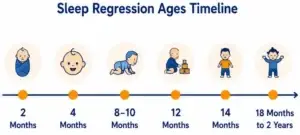
Not every child hits every stage. Some toddlers sail through certain ages without a single rough night, while others struggle at almost every one.
What Triggers a Regression
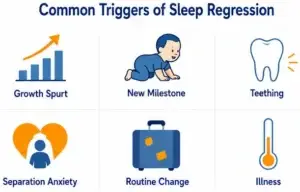
- A growth spurt that increases hunger and restlessness
- A new developmental milestone, like rolling, crawling, or walking
- Teething pain that flares at night
- Separation anxiety, which often peaks between 15 and 18 months
- A change in routine, such as travel, illness, or starting daycare
- Minor illness, including colds or ear infections
Watch for a cluster of signs rather than one: more night waking, nap refusal, harder crying at bedtime, earlier mornings, daytime clinginess, and appetite changes. Several at once, at one of the ages above, points to a regression.
Tips That Work at Every Age
- Stick to the same bedtime routine every night, even on hard nights
- Put your child down drowsy but still awake so they practice settling alone
- Keep the room dark, cool, and quiet, and consider white noise
- Offer a comfort object for toddlers old enough for one
- Feed well during the day so hunger is not the reason for waking
- Stay consistent with your response, even if change takes a few nights
Tracking wake windows helps beyond the 4 month stage too: a toddler who naps too long or too late fights bedtime harder. And keep the hour before bed calm rather than exciting.
One physical note for parents in the thick of it: the endless lifting, rocking, and carrying through regression weeks is exactly how mommy thumb, a painful wrist tendon condition, develops. If your wrist aches, that guide covers early fixes.
Is There a Treatment for Sleep Regression?
No, because it is not an illness. Pediatricians recommend consistent routines over any product. Melatonin and sleep supplements are not the answer for babies or toddlers, a topic our guide on sleep gummies covers, and no sleep aid should reach a child without a pediatrician’s explicit direction.
Some families choose gentle sleep training methods once a baby is old enough, usually after 4 to 6 months, and that timing lines up neatly with the 4 month regression’s settling skill problem. Check with your pediatrician before starting, especially if your baby was born early or has a medical condition.
Safe sleep rules hold through every regression: the CDC recommends back sleeping on a firm, flat surface for every sleep, with no loose blankets or soft toys in the crib.
When to See a Doctor
Call your pediatrician if you notice any of the following.
- Sleep problems lasting longer than 6 weeks without improvement
- Signs of illness, such as fever, congestion, or pulling at the ears
- Poor weight gain or a noticeable appetite drop
- Loud snoring, gasping, or pauses in breathing during sleep
- Extreme lethargy or a baby who is unusually hard to wake
- Any regression that comes with a loss of skills your child already had
A quick call can rule out an ear infection or reflux, both of which hide behind what looks like a typical regression.
Sleep regression tests every parent’s patience, but it passes, even the 4 month one once the settling skill lands. Lean on routines, share the night shifts if you can, and trust that your child’s sleep will settle again.
Frequently Asked Questions
How long does the 4 month sleep regression last?
Two to six weeks is typical, but this one is different from the others: the sleep cycle change behind it is permanent, so the timeline depends on how quickly your baby learns to resettle between cycles. Babies who practice falling asleep drowsy but awake usually come through faster, and the skill carries into every later regression.
What are wake windows for a 4 month old?
About 1.5 to 2.5 hours of awake time between sleeps, shortest in the morning and slightly longer before bedtime. Watching for sleepy cues inside that window beats following the clock, because an overtired baby fights sleep harder and wakes more often.
When do babies go through sleep regression?
The first noticeable one usually lands around 4 months when sleep cycles mature. After that, common stages are 8 to 10 months, 12 months, 14 months, and between 18 months and 2 years. Timing and intensity vary by child, and some skip stages entirely.
How many sleep regressions are there in the first two years?
Most children move through four to six, at roughly 2 months, 4 months, 8 to 10 months, 12 months, 14 months, and 18 months to 2 years. Not every child experiences each one.
Is sleep regression in newborns common?
True regression under six weeks is uncommon, since a regression needs an established pattern to disrupt. What looks like newborn regression is usually just normal, fragmented newborn sleep.
Does teething cause sleep regression?
Teething pain can disrupt sleep and often overlaps with regression windows, especially around 8 months and again near 14 months when molars arrive. The discomfort, not the regression itself, usually drives the extra waking, and it settles once the tooth is through.