
Side sleeping is the best position for sleep apnea, because gravity pulls soft tissue away from your airway instead of into it. Left side is slightly better if you also have reflux. The real challenge is staying on your side all night, which is where positional devices come in, from a body pillow to wearable trainers that buzz when you roll onto your back.
You probably already know sleep apnea disrupts your breathing at night. According to a 2025 study in Respiratory Medicine, roughly 83.7 million US adults live with sleep apnea, and most are managing it without knowing how much their sleep position affects their symptoms.
Why Position Changes Everything
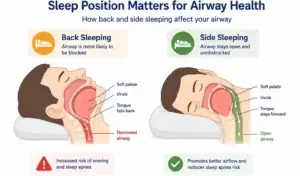
Sleep apnea happens when your throat muscles relax too much during sleep. Soft tissue collapses and blocks your airway, your brain wakes you just enough to restart breathing, and in severe cases this repeats more than 30 times per hour.
When you sleep on your back, gravity pulls your tongue and soft palate directly into your airway. When you roll onto your side, gravity works for you instead. Research published in a 2025 meta analysis confirmed that lateral sleeping significantly reduces the apnea hypopnea index, or AHI, the count of how many times per hour your breathing stops. Lowering AHI is the core goal of every sleep apnea treatment.
Is Your Sleep Apnea Positional? Check This First
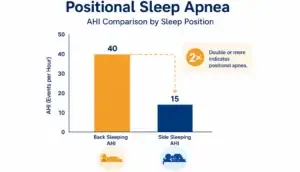
Here is the detail that decides how much this article can help you: for roughly half of people with obstructive sleep apnea, breathing events happen mostly or entirely while sleeping on their back. Doctors call this positional sleep apnea, and it is the group for whom position changes deliver the biggest results.
Three ways to find out if you are in that group.
- Check your sleep study report. Lab and home sleep tests record body position alongside breathing events. If your AHI on your back is at least double your AHI on your side, your apnea is positional by definition. If you had a study done, this number is already in the report, ask your doctor to read it with you.
- Ask your partner. Snoring and gasping that happen mainly when you are on your back, and quiet down when you turn, is the informal version of the same signal.
- Get tested if you never have been. No positional strategy should replace an actual diagnosis, since severity decides whether position therapy can lead or must only assist CPAP.
If your events happen equally in every position, side sleeping still helps, but treatment like CPAP carries the load, and the sections below become supporting tactics.
The Best Positions, Ranked
Side Sleeping
Side sleeping is the best position for most people with sleep apnea. Research consistently shows it keeps the airway more open than any other position, and left side sleeping edges out the right because it also reduces acid reflux, which commonly accompanies sleep apnea and worsens nighttime breathing.
One side effect worth managing: side sleepers put body weight on the lower arm, which is why some people trade apnea events for a numb arm. Our guide on why arms go numb while sleeping covers the arm positions that prevent it, so you can keep the side sleeping habit comfortably.
Head Elevation
Raising your upper body 30 to 45 degrees with a wedge pillow or adjustable base reduces gravitational pressure on the airway, and helps reflux too. Stacked regular pillows will not hold the angle through the night, a dedicated wedge keeps its shape until morning.
Stomach Sleeping
Better than back sleeping for the airway, worse for your neck and lower back over time. Treat it as a transitional option while you train yourself onto your side, not a destination.
Devices That Keep You Off Your Back
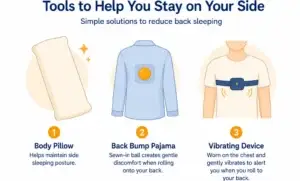
Knowing side sleeping helps is easy. Staying on your side through deep sleep is the hard part, since most people roll onto their back without waking. These options solve that, from free to clinical.
The body pillow barrier. Press a body pillow firmly against your back as you fall asleep on your side. It physically blocks the roll. Costs nothing if you own the pillow, and it is the first thing to try.
The tennis ball technique. Sew a tennis ball or firm object into a pocket on the back of your pajama top. Rolling onto your back becomes uncomfortable enough that you turn again without fully waking. Studies on positional therapy confirm this reduces back sleeping time and lowers AHI. The known weakness is compliance, since some people eventually abandon the discomfort.
Wearable position trainers. The modern replacement for the tennis ball: small devices worn on the chest or neck that detect when you roll onto your back and respond with a gentle, escalating vibration until you turn. Trials show AHI reductions comparable to the tennis ball approach with much better long term compliance, because a buzz beats a lump in your back. These are worth asking a sleep specialist about if positional apnea is confirmed, and some are available with a prescription or through sleep clinics.
Pillows that support the strategy. Wedge pillows for elevation, cervical contour pillows for neck alignment that keeps the airway straighter, and CPAP pillows with side cutouts so a mask survives turning. No pillow cures sleep apnea, but the right one makes the position plan stick.
None of these replace CPAP for moderate to severe sleep apnea. For confirmed mild positional apnea, they can meaningfully cut nightly breathing interruptions.
Home Habits With Real Evidence
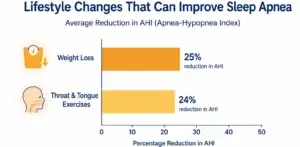
Weight loss. Losing 10 to 15 percent of body weight can reduce AHI substantially when excess weight is the driver. In December 2024, the FDA approved tirzepatide, sold as Zepbound, for adults with obesity and moderate to severe sleep apnea, the first drug approved for this combination.
Throat and tongue exercises. Myofunctional therapy strengthens the muscles that hold the airway open. A systematic review found it reduced AHI by about 50 percent in adults. A speech therapist can structure the program.
No alcohol within 3 to 4 hours of bed. Alcohol relaxes throat muscles beyond normal, and even one or two evening drinks increase airway collapses. Sedating medications, including some antihistamines and sleeping pills, do the same. This includes melatonin products, which can mask apnea symptoms without treating them, a point our guide on sleep gummies covers.
Bedroom humidity between 40 and 60 percent. Dry air congests nasal passages and narrows the airway before you even fall asleep.
Can Sleep Apnea Go Away on Its Own?
It depends on the cause. Weight related sleep apnea can improve significantly with weight loss and sometimes resolve. Structural causes, a small jaw or deviated septum, rarely improve without targeted treatment and often worsen with age. In children, apnea often resolves after tonsil or adenoid removal.
For adults, waiting it out is rarely safe. And feeling less tired does not prove the apnea is gone, only a follow up sleep test does. Talk to your doctor before changing any treatment.
Positions and Tools at a Glance
| Option | Best For | Limitation |
| Side sleeping | Most people with sleep apnea | Hard to maintain all night |
| Left side specifically | Apnea plus acid reflux | Requires habit training |
| Head elevated 30 to 45 degrees | Moderate apnea plus reflux | Needs wedge or adjustable base |
| Body pillow barrier | First free step | Can shift during the night |
| Tennis ball technique | Confirmed positional apnea | Comfort limits long term use |
| Wearable position trainer | Positional apnea, better compliance | Cost, may need prescription |
| Stomach sleeping | Transition away from back sleeping | Neck and back strain |
When to See a Doctor
See your doctor if you snore loudly and regularly, wake up gasping or choking, feel exhausted regardless of sleep duration, or your partner says you stop breathing at night. Untreated sleep apnea raises the risk of high blood pressure, heart disease, and stroke, and contributes to an elevated resting heart rate and irregular rhythms over time. If your current treatment is not fully controlling symptoms, the fix is usually combining approaches, and position therapy stacks with almost everything.
Frequently Asked Questions
What is the best sleep position for sleep apnea?
Side sleeping, for most people. It uses gravity to keep soft tissue away from the airway instead of pulling it in. Left side sleeping is slightly preferred because it also reduces acid reflux, which often accompanies sleep apnea and aggravates nighttime breathing.
How do I know if my sleep apnea is positional?
Your sleep study holds the answer: if your AHI while on your back is at least double your side sleeping AHI, your apnea is positional. Roughly half of people with obstructive sleep apnea fit this pattern. A partner noticing that snoring and gasping happen mainly on your back is the informal version of the same evidence.
Do the tennis ball trick and position trainers actually work?
For confirmed positional apnea, yes. Both reduce time spent on the back and lower AHI in studies. Wearable trainers that vibrate when you roll over achieve similar results with better long term compliance than the tennis ball. Neither replaces CPAP for moderate to severe apnea.
What are the best home remedies for sleep apnea?
Side sleeping, head elevation, weight loss, throat exercises, avoiding alcohol within four hours of bed, and keeping bedroom humidity between 40 and 60 percent all have research support. They reduce severity and make treatment work better, but they do not replace a CPAP for moderate to severe cases.
Can sleep apnea go away on its own?
Rarely in adults. Weight driven apnea can improve substantially with weight loss and occasionally resolve, while structural causes tend to persist or worsen with age. Any apparent improvement should be confirmed with a sleep test before changing treatment.
Is there a pillow for sleep apnea without a CPAP?
Wedge pillows and cervical contour pillows are the most useful, elevation reduces airway collapse and neck alignment keeps the airway straighter. They reduce severity rather than cure anything, and moderate to severe apnea still needs medical treatment.