
If your doctor has recommended a hida scan, you probably have questions about what it involves and why it is needed.
A hida scan is a nuclear medicine imaging test that checks how well your liver, gallbladder, and bile ducts are working. It tracks bile flow in a way that a standard ultrasound simply cannot replicate. Knowing what to expect ahead of time can make the experience far less stressful.
What Is a HIDA Scan
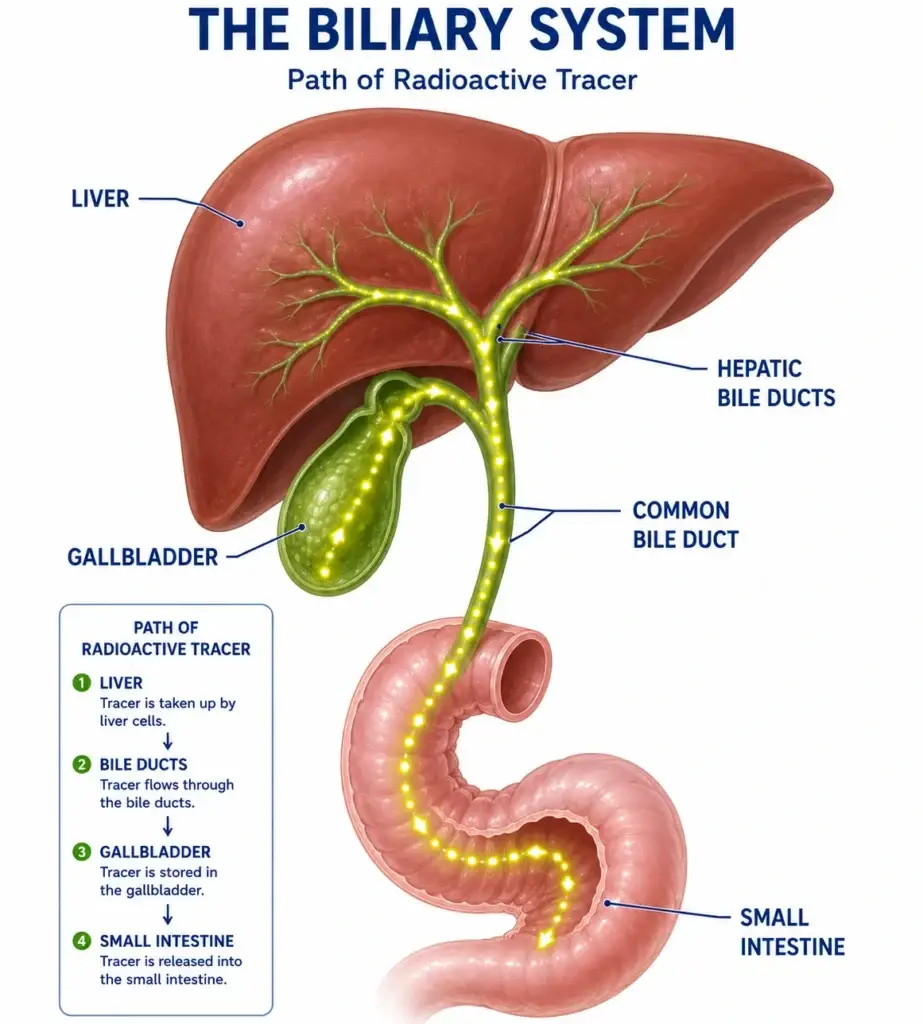
A hida scan stands for hepatobiliary iminodiacetic acid scan. Doctors also call it cholescintigraphy or a hepatobiliary scan. It belongs to the category of nuclear medicine imaging, which uses a very small amount of radioactive material to measure how your organs are functioning.
During a hida scan, a technician injects a radioactive tracer into a vein in your arm. Your liver absorbs the tracer and passes it into bile. The tracer then moves through your bile ducts, fills your gallbladder, and enters your small intestine. A gamma camera follows this journey and sends images to a computer screen in real time.
This test is especially useful because it shows organ function, not just physical shape. Rather than only seeing what your organs look like, your doctor gets to see how well they are actually performing.
What Can Be Diagnosed with a HIDA Scan
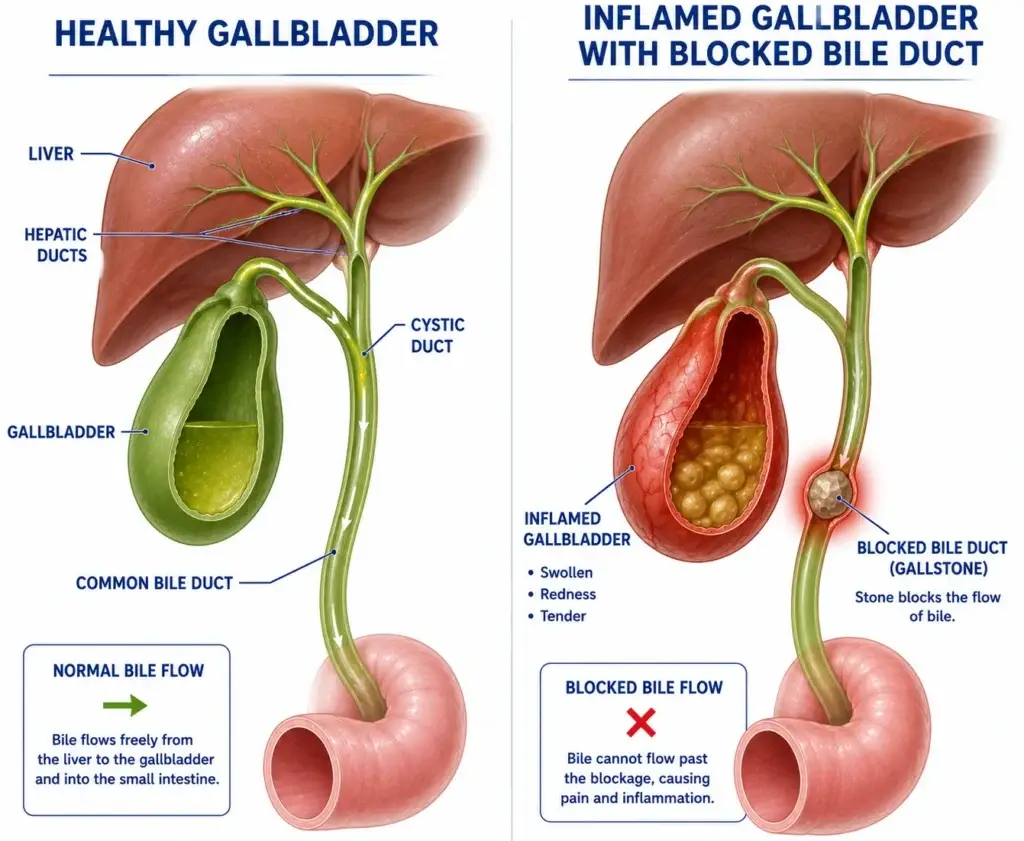
A hida scan helps doctors identify several conditions that affect the liver, gallbladder, and bile ducts. Doctors typically order one after an ultrasound comes back normal but symptoms continue to suggest a biliary problem.
A hida scan can help diagnose all of the following.
- Acute cholecystitis, a sudden and severe gallbladder inflammation
- Chronic cholecystitis, a recurring inflammation that causes repeated pain episodes
- Biliary dyskinesia, where the gallbladder fails to empty properly despite no visible stones
- Bile duct blockages from stones, scar tissue, or tumors
- Bile leaks that can develop after gallbladder surgery
- Biliary atresia, a rare bile duct condition found in newborns
- Sphincter of Oddi dysfunction, which disrupts the valve controlling bile flow into the intestine
Each condition responds differently to treatment, so an accurate diagnosis makes a real difference in the care you receive.
How the HIDA Scan Procedure Works
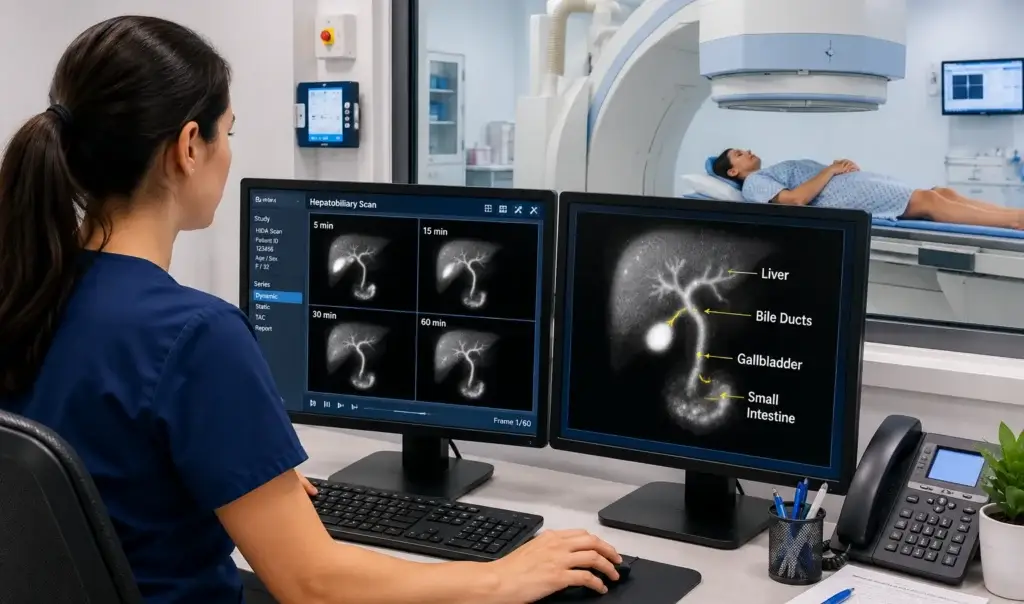
The hida scan procedure is noninvasive and well tolerated by most patients. Understanding the steps ahead of time, though, helps reduce any worry on the day.
What to Do Before a HIDA Scan
Your care team will give you personalized instructions. Most patients follow these standard preparation guidelines.
- Fast for at least 4 to 6 hours before the scan. Your doctor may direct you to fast up to 12 hours.
- Tell your doctor about every medication you currently take, as some drugs affect test results
- Remove all jewelry and metal items before entering the scanning room
- Let your provider know if you are pregnant, breastfeeding, or think you might be pregnant
If you are unsure whether you might be pregnant, check our article on early pregnancy symptoms. It covers the early signs to watch for.
Morphine may also be used during the hida scan if your gallbladder does not appear in the early images. Your technician will explain this possibility before the scan starts.
What Happens During the HIDA Scan Procedure
On the day of your hida scan, a technician places a small intravenous (IV) line into your arm. The radioactive tracer then flows through the IV into your bloodstream. You lie flat on a padded exam table while the gamma camera is positioned above your abdomen.
The camera takes a series of images as the tracer moves through your biliary system. You need to stay still, but you do not need to hold your breath. Meanwhile, the technician monitors everything on a nearby computer screen.
At some point, you may receive an injection to stimulate your gallbladder to contract and empty. This can cause brief cramping in your upper right abdomen. Additional images are captured right after to show how your gallbladder responds.
How Long Does a HIDA Scan Take
How long a hida scan takes depends on how quickly your gallbladder responds to the radioactive tracer.
Most hida scans are completed within one to two hours. Some extend to three or four hours if your gallbladder is slow to fill. In certain cases, your doctor may also request follow up images up to 24 hours after the initial session.
If your hida scan includes a CCK injection, plan for an additional 30 to 60 minutes. The next section explains what CCK is and when it is added. Overall, keeping two to three hours free on the day of your appointment is a sensible approach.
What Is a HIDA Scan with CCK
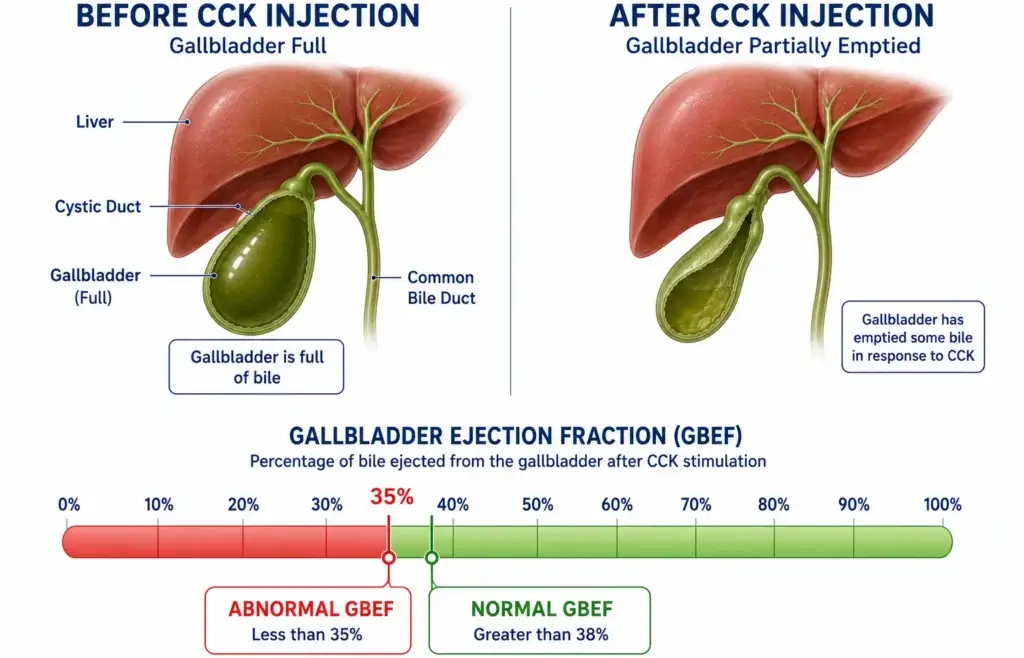
A hida scan w/cck adds an important extra step to the standard test. CCK stands for cholecystokinin, a hormone your body naturally releases after eating. In healthy digestion, CCK signals your gallbladder to contract and push bile into your small intestine.
During this version of the test, a synthetic form of CCK is injected through your IV. This happens after the initial imaging phase is complete. The injection forces your gallbladder to contract, allowing the camera to measure exactly how much bile it releases. That measurement is called the gallbladder ejection fraction, or GBEF.
Research from the NIH’s National Library of Medicine shows that a GBEF above 38% is generally considered normal. A result below 35% may indicate biliary dyskinesia or chronic cholecystitis. This can be true even when other imaging shows no gallstones.
This version of the hida scan is most useful for patients with persistent biliary pain and a normal ultrasound. It gives doctors the functional data needed to decide whether gallbladder surgery is likely to bring relief.
Understanding Your HIDA Scan Results
After your hida scan, a radiologist reviews all the images and writes a report for your referring doctor. Your doctor then discusses those findings with you at an appointment or by phone.
Normal results show that the tracer moved steadily from your liver through your bile ducts. It should also fill your gallbladder fully and pass smoothly into your small intestine. A normal gallbladder ejection fraction is likewise part of a healthy result.
Abnormal results may reflect one or more of these patterns.
- No gallbladder filling on the images, which often points to acute cholecystitis
- Very slow tracer movement through the bile ducts, suggesting a possible blockage
- Tracer visible outside the biliary system, indicating a bile leak
- A low ejection fraction, supporting a diagnosis of biliary dyskinesia or chronic cholecystitis
According to the Cleveland Clinic, hida scan findings are central to key treatment decisions in gallbladder care. Your doctor will outline the next steps based on what your specific scan reveals.
Is a HIDA Scan Safe
Yes, a hida scan is considered safe for most patients. The radioactive tracer delivers a very small radiation dose. This dose is roughly equal to the natural background radiation a person receives over the course of one year.
Serious side effects are rare. Some patients notice mild soreness or bruising at the IV site after the test. Brief cramping during the CCK stimulation phase is also common but passes quickly. Allergic reactions to the tracer are uncommon, though your care team is always ready to respond if one occurs.
If you are pregnant or breastfeeding, speak with your doctor before scheduling the hida scan. Your provider will weigh the benefits and risks with you directly.
When to See a Doctor
Not every case of upper abdominal pain points to a gallbladder problem. However, certain symptoms suggest it is worth asking your doctor about a hida scan.
Talk to your doctor if any of these apply to you.
- Recurring pain in the upper right abdomen, especially after fatty or greasy meals
- Nausea or vomiting that keeps coming back without a clear cause
- Yellowing of your skin or eyes, known as jaundice
- Fever and chills alongside abdominal pain
- Persistent bloating, gas, or indigestion that does not improve
Abdominal pain can overlap with other digestive conditions. Our article on gastritis symptoms, causes, and treatment covers stomach inflammation that often mimics gallbladder pain. Similarly, nausea and cramping are also common symptoms of stomach flu and food poisoning. Getting an accurate diagnosis is essential.
Seek emergency care right away if you have severe abdominal pain alongside a high fever. A fast heart rate in that situation can point to a serious biliary infection. Our article on elevated heart rate when sick explains when a rapid heart rate becomes a medical urgency.
Frequently Asked Questions
What is a HIDA scan used for?
A hida scan evaluates how well your liver, gallbladder, and bile ducts are functioning. It helps diagnose conditions such as gallbladder inflammation, bile duct blockages, and biliary dyskinesia. Doctors commonly order a hida scan when an ultrasound has not explained ongoing abdominal symptoms.
How long does a HIDA scan take?
Most hida scans take between one and two hours to complete. Some extend to three or four hours if your gallbladder responds slowly to the tracer. Adding a CCK injection extends the total appointment by another 30 to 60 minutes. Plan for at least two to three hours when booking your scan.
What is a HIDA scan with CCK?
A hida scan w/cck uses a synthetic digestive hormone to stimulate gallbladder contraction during the scan. This allows doctors to measure the gallbladder ejection fraction and check whether the gallbladder empties normally. It is most helpful when biliary symptoms are present but no stones appear on ultrasound.
Does a HIDA scan show gallstones?
A hida scan does not directly detect gallstones the way an ultrasound does. Instead, it measures how well the biliary system is functioning. It can reveal the effects of gallstones, such as a blocked duct or an inflamed gallbladder. Ultrasound remains the standard tool for locating gallstones directly.
Is a HIDA scan painful?
A hida scan is not painful for most patients. You may feel a brief pinch when the IV is placed. Some patients experience mild cramping during the gallbladder stimulation phase, but this passes within a few minutes. Most people tolerate the hida scan well and return to normal activities the same day.
What is a hidascan and how is it different from an ultrasound?
A hidascan, also written as HIDA scan, is a nuclear medicine test. It tracks bile flow to assess how your biliary organs function. An ultrasound, by contrast, uses sound waves to produce images of physical structures. Both tests are often used together because they give doctors two different but complementary views of gallbladder health.